Are Whole House Water Filter Systems Worth It in Grand Prairie?
An honest look at what a whole-home system does well, where it falls short, and how to tell which camp your home falls into.
Are whole house water filter systems worth it?
Yes, a whole house water filter is worth it when the problem you notice comes from something it actually removes, like chlorine taste and odor, sediment, or that pool smell in the shower. It is not worth it if the real issue is hardness or something only a drinking water system handles. Testing first tells you which. (972) 945-8548
What does a whole house water filter actually do?
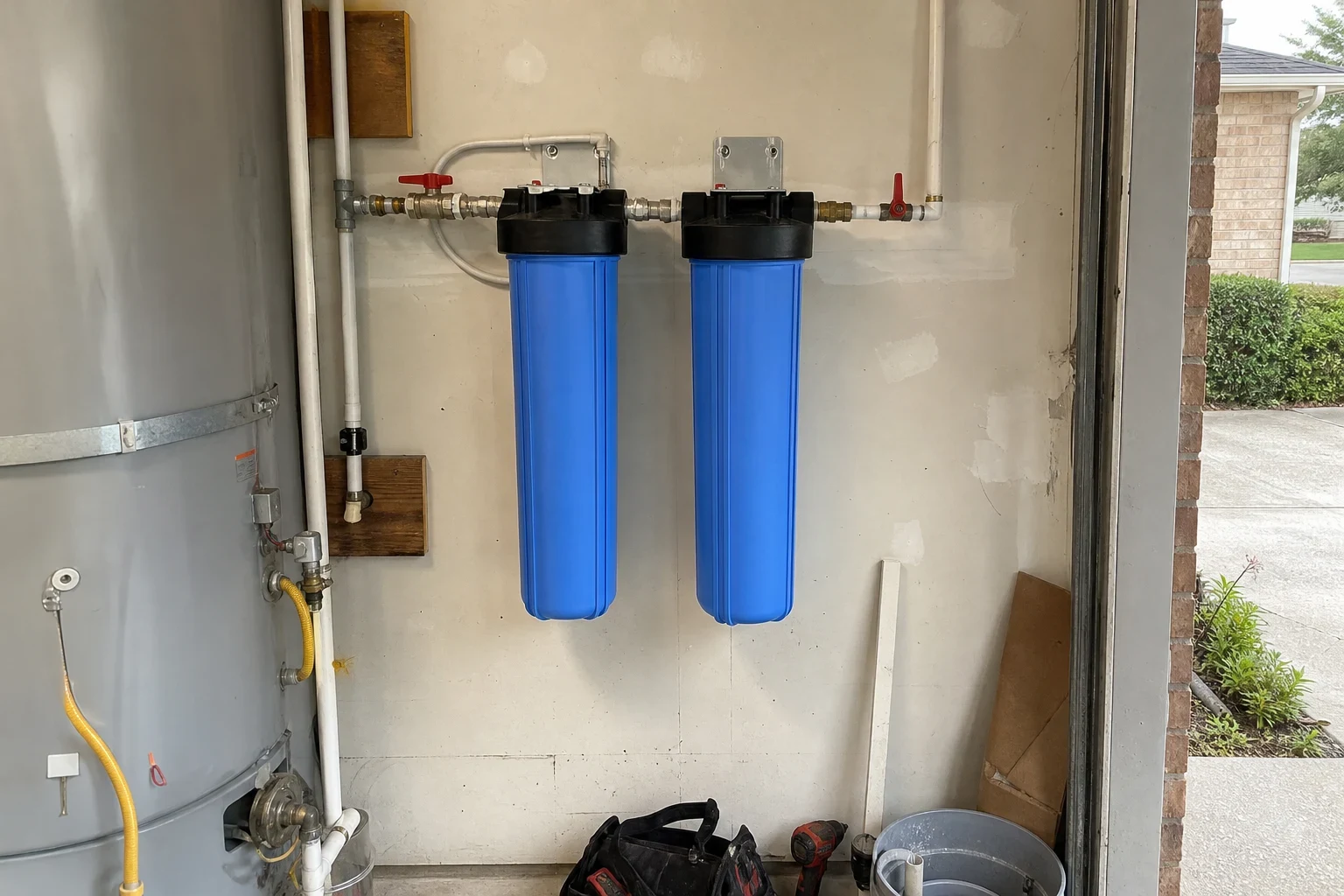
A whole-home system sits where the water line enters your home, usually near the main shutoff or the water heater. Every tap, shower and appliance gets filtered water, not just the kitchen sink.
Most systems use a sediment stage to catch grit and rust flakes, then a carbon stage to take out chlorine or chloramine and the taste and smell that come with them. That covers the complaints we hear most from homeowners on city water: water that smells like a swimming pool, a chemical taste in coffee, and skin or hair that feels dry after a shower.
- Reduces chlorine taste and odor at every faucet
- Catches sediment before it reaches fixtures and appliances
- Protects showerheads and faucet aerators from grit buildup
- Gives you better-tasting water for cooking, ice and pets, not just drinking
When is a whole-home system the wrong fix?
This is where a lot of people get oversold. A carbon filter does not soften water. If your problem is white crust on faucets, spots on glasses or scale inside the water heater, that is hardness, and a water softener is the tool for it. A filter alone will leave you paying for equipment while the spots keep coming back.
Some concerns also call for a point-of-use system instead. If you want extra assurance about trace contaminants or lead from older plumbing in your drinking and cooking water, an under-sink reverse osmosis unit does that job more thoroughly than a whole-home carbon filter. Many homes end up with both, but plenty only need one.
That is why we start by finding the actual cause. Matching the equipment to what is really in your water is the difference between a system you are glad you bought and one you regret.
How do you know what your water needs?
Start with what you notice. Smell and taste problems point toward carbon filtration. Scale, spotting and soap that will not lather point toward hardness. Concerns about what you are drinking point toward reverse osmosis. Then confirm it with a test instead of guessing.
We test the water at your home and put the results in a water report, so you can see what is actually coming out of your tap before anyone recommends equipment. We walk through the findings with you in plain terms, including what does not need fixing. If your water is fine for your needs, we will tell you that too.
- Pool or chemical smell: likely chlorine or chloramine
- White crust and spotty dishes: likely hardness
- Reddish or brown stains: possibly iron or older pipes
- Worry about drinking water quality: consider reverse osmosis
What affects whether the investment pays off?
The value depends on how you use your water and what you are trying to protect. A larger household running more showers and laundry gets more out of whole-home filtration than a single person who mainly cares about drinking water. Homes with newer fixtures, a tankless water heater or expensive appliances also benefit from keeping sediment out of the lines.
Upkeep matters too. Carbon and sediment cartridges need changing on a schedule based on your water use and filter size. A system that is never serviced stops doing its job, so ask how often filters need replacing and how easy the housing is to reach before you decide. Placement in a garage or utility closet makes changes quick; a cramped spot can make them a chore.
In Grand Prairie summers, outdoor plumbing and garages get hot, so we plan the install location with that in mind to keep the equipment easy to service and protected.
What does installation involve?
The plumber cuts into the main line, adds the filter housing with shutoff valves and a bypass, and checks for leaks before restoring water. Your water is off for part of the visit, and we let you know ahead of time so you can plan around it.
Standard professional installation is included for qualifying homes. We protect the work area, clean up when we are done, and show you how to bypass the system and change the filters yourself.
More questions about whole house filters
Something not covered here? (972) 945-8548
Will a whole house filter lower my water pressure?
A correctly sized system should not cause a noticeable drop. Pressure loss usually comes from an undersized unit or a clogged cartridge that is overdue for a change.
Do I still need a refrigerator filter?
Many homeowners keep it as a final polish for ice and drinking water, but with good whole-home filtration it matters less. An under-sink reverse osmosis line to the fridge is another option.
Can I combine a filter and a softener?
Yes. If testing shows both chlorine taste and real hardness, the two systems work well together, usually with the filter installed ahead of the softener.
Do you serve areas outside Grand Prairie?
Yes, we work with homeowners in nearby cities including Arlington, Mansfield, Cedar Hill and Irving.
Find out what your water really needs
Give us a call and we will set up a water test at your home, explain what we find in plain language, and give you a quote only for the equipment that solves your actual problem.